
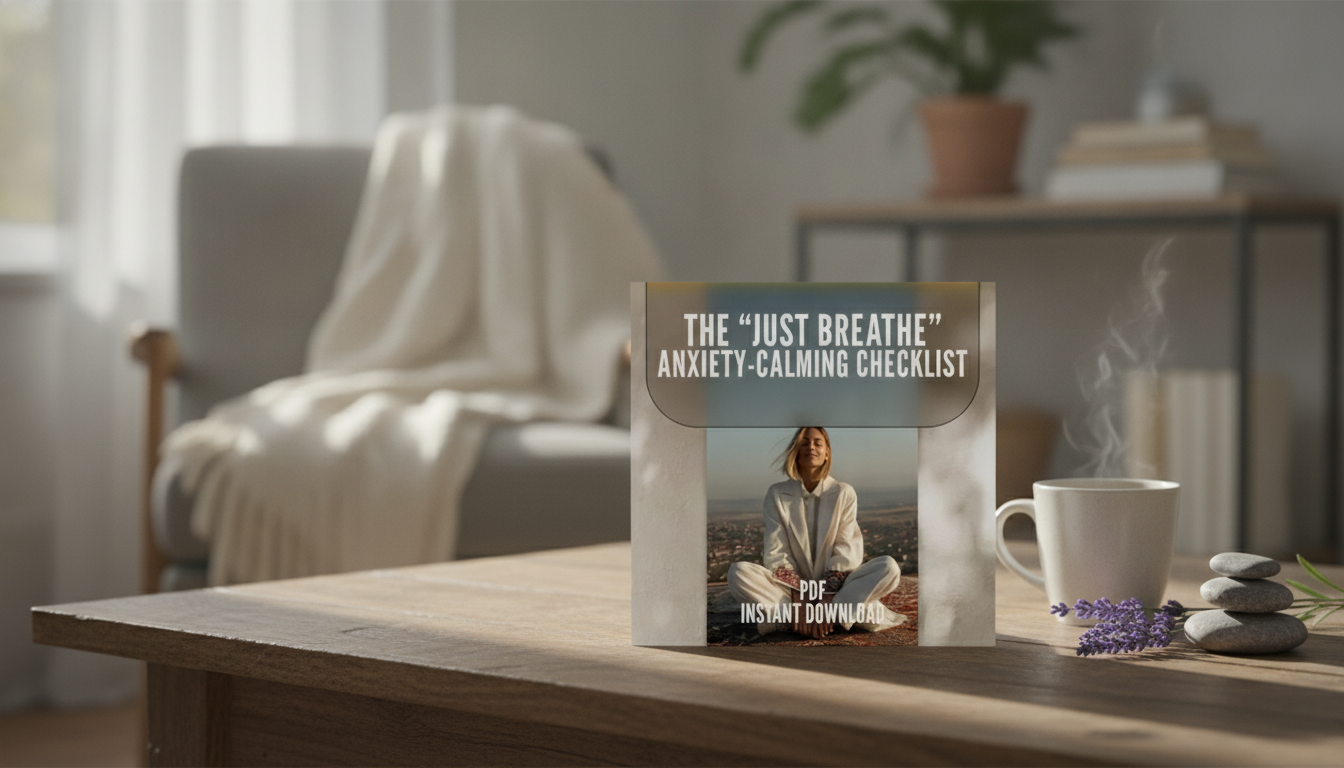
When anxiety spikes, decision-making gets harder and the body’s stress response can take over. A short, repeatable breathing routine can provide a clear next step—especially when it’s written down as a checklist. This digital download offers a quick sequence of calming breaths and grounding cues designed for use at home, work, school, or while traveling.
The “Just Breathe” checklist is a printable or save-to-phone guide that walks you through a short calming sequence: a few simple reset steps, a breathing pattern, and a quick grounding cue. The goal is to lower “friction” in the moment—fewer choices, a clearer order, and a routine that feels familiar the more you repeat it.
It’s especially useful for acute moments like a racing heart, a tight chest, shaky hands, or spiraling thoughts. It also works well as a brief daily practice to build a steadier baseline. Over time, repeating the same steps can make the routine feel more automatic when stress hits.
Breathing tools can be a helpful part of a broader self-care plan (sleep, hydration, movement, social support), but they aren’t a replacement for clinical care. For a deeper overview of anxiety disorders and when to get help, visit National Institute of Mental Health (NIMH) — Anxiety Disorders.
Slow, controlled breathing can shift the body toward a calmer state by influencing the autonomic nervous system. When anxiety rises, breathing often becomes shallow and fast, which can intensify that “revved up” sensation. Slowing the breath—especially lengthening the exhale—often feels soothing and steadying.
Breathing also works like an anchor for attention. Instead of scanning for threats or chasing worst-case thoughts, your mind returns to something predictable: the count, the airflow, and the rhythm. That predictability can be comforting when your environment or internal sensations feel uncertain.
A checklist format supports follow-through during stress, when memory and focus can dip. If you’ve ever known what might help but couldn’t remember the steps in the moment, a simple prompt can make the difference between spiraling and regaining footing. For more on how stress affects the body, see American Psychological Association — Stress effects on the body. For a detailed look at breath control as a relaxation technique, see Harvard Health Publishing — Breath control helps quell errant stress response.
This short sequence is designed to be realistic—something you can do in a bathroom stall, at your desk, in a parked car, or before a difficult conversation.
Silently label what’s happening: “anxiety spike,” “panic sensations,” or “stress wave.” Putting a name on it can reduce mental overwhelm and create a small pause between you and the feeling.
Plant your feet. Let shoulders soften. Unclench your jaw. Relax the tongue from the roof of the mouth. A supportive posture can make breathing feel easier without forcing anything.
Pick a single pattern and repeat for 6–10 rounds. Consistency matters more than intensity; gentle breaths tend to work better than “big” breaths that make you lightheaded.
Keep it simple: notice 3 things you can see, 2 things you can feel, and 1 thing you can hear. This pulls attention out of the spiral and back into the present.
Notice your heart rate, muscle tension, and the speed of thoughts. If you still feel activated, repeat the cycle once or twice. Progress can be subtle; “5% calmer” still counts.
A great checklist includes options—while still encouraging a “default” choice. Below are four common patterns used for calming and downshifting.
| Technique | How to do it | Best for | If it feels too intense |
|---|---|---|---|
| Box breathing | Inhale 4 • Hold 4 • Exhale 4 • Hold 4 (repeat) | Racing thoughts, pre-meeting nerves | Reduce to 3 counts or skip holds |
| Extended-exhale | Inhale 4 • Exhale 6 (repeat) | Tension, restlessness | Try inhale 3 • exhale 4 |
| 4-7-8 pacing | Inhale 4 • Hold 7 • Exhale 8 (repeat) | Settling for sleep | Shorten holds (e.g., 4-4-6) |
| Physiological sigh | Inhale • small second inhale • long exhale | Rapid downshift during a spike | Do fewer rounds; return to normal breathing |
If you notice lightheadedness, ease up: breathe more gently, reduce breath holds, shorten counts, and return to normal breathing for a moment. Calm is the goal—not intensity.
The “Just Breathe” Anxiety-Calming Checklist (digital download)
For a guided approach that complements breathing routines, consider adding: The Relaxation Hypnosis Checklist for Clarity (digital download).
Often within a few minutes, especially with slower breathing and longer exhales, but results vary by person and situation. Practicing when calm helps the routine work better during spikes, and repeating 2–3 cycles can deepen the effect.
Ease the intensity: breathe more gently, reduce breath holds, shorten the counts, and return to normal breathing until you feel steady. If dizziness is persistent or concerning, discuss it with a clinician.
No. It’s a supportive tool for self-regulation and symptom management, not a replacement for professional treatment. If anxiety is ongoing, severe, or impairing daily life, seeking clinical support is the safest next step.









Leave a comment