
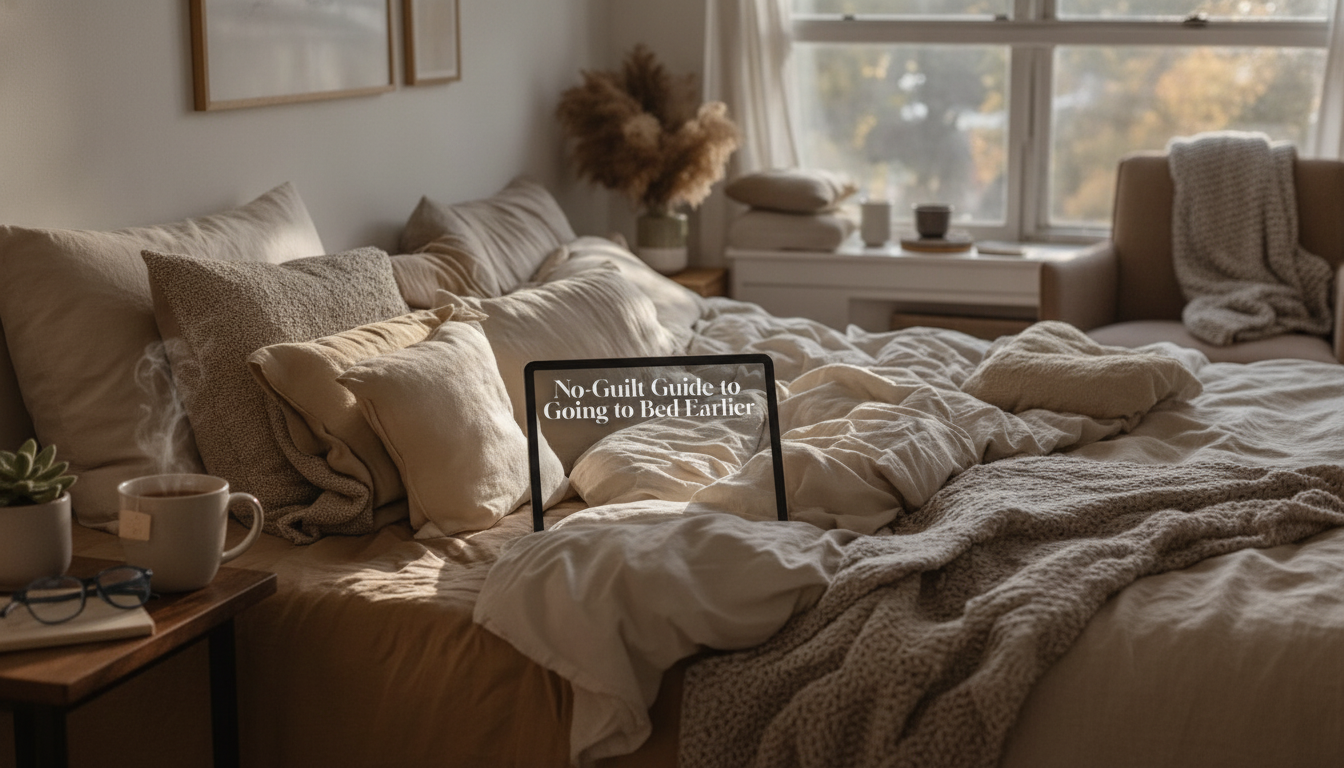
Going to bed earlier sounds simple—until it’s 11:47 p.m. and “one more thing” turns into an hour. The goal isn’t to force a strict bedtime; it’s to make earlier sleep feel like a relief instead of a loss. This guide-style approach focuses on lowering friction, easing the guilt spiral, and building an evening rhythm that actually sticks.
Late nights don’t happen because of a character flaw. They happen because the modern evening is designed to keep you “on,” even when your body is ready to power down.
If you want a practical baseline for evening habits that support sleep, the Sleep Foundation’s overview of sleep hygiene is a helpful reference point.
Guilt drains motivation. It also makes bedtime feel like a verdict instead of a choice. A better approach is to treat sleep as support for the person you’ll be tomorrow.
A solid reset rule: if you’re up late, keep the next day’s basics steady (wake time, meals, light movement) and return to your routine that night—no “I’ll fix it by doing everything perfectly” bargain required.
Earlier sleep sticks when the evening has shape. Instead of trying to white-knuckle your way to bed, build a short sequence your brain recognizes.
| Step | What it does | Examples (pick one) |
|---|---|---|
| Cue | Signals the brain that the day is shifting | Dim lamps, change into sleep clothes, start a specific playlist |
| Comfort | Lowers stress without revving you up | Gentle stretches, breathing exercise, gratitude list, light fiction |
| Cutoff | Prevents “accidental” late-night momentum | Phone on charger, TV off at a set time, notifications muted |
A dramatic bedtime change often backfires: you get into bed earlier, can’t fall asleep, and your brain learns “earlier bedtime = frustration.” Instead, nudge your schedule like you’d adjust to a new time zone.
For general, science-backed sleep habit guidance, the CDC’s page on healthy sleep habits offers clear, practical pointers that pair well with this incremental method.
If sleep problems are lasting and disruptive, the National Institute of Neurological Disorders and Stroke provides a straightforward overview of insomnia, including when to seek additional support.
If you want a structured version of this plan you can reuse whenever life gets busy again, Lights Out: The No-Guilt Guide to Going to Bed Earlier (and Actually Liking It) | Digital Guide for How to Stop Staying Up Late is built to be practical, not preachy.
For extra help when your mind feels noisy, pair it with The Relaxation Hypnosis Checklist for Clarity | Digital Relaxation Hypnosis Guide & Self-Care Checklist PDF—a quick, low-lift option for calming down without turning wind-down time into another task to “do perfectly.”
Shift earlier in 10–15 minute increments every few nights, keep your wake time as steady as possible, and add a calm wind-down so your body has time to downshift. If you’re still awake after about 20 minutes, get up for a low-light, quiet activity and return to bed when you feel sleepy.
Protect a small pocket of “me time” earlier in the evening (even 15 minutes) and treat your wind-down as personal time, not a chore. Replace scrolling with something that still feels like yours—light reading, a playlist, stretching, or a guided relaxation—so you get the decompression without the late-night spiral.
Melatonin timing and dosing can be individual, so it’s best to check with a qualified healthcare professional for personalized guidance. For many people, consistent light/screen boundaries and a repeatable wind-down routine do most of the heavy lifting for shifting bedtime earlier.












Leave a comment