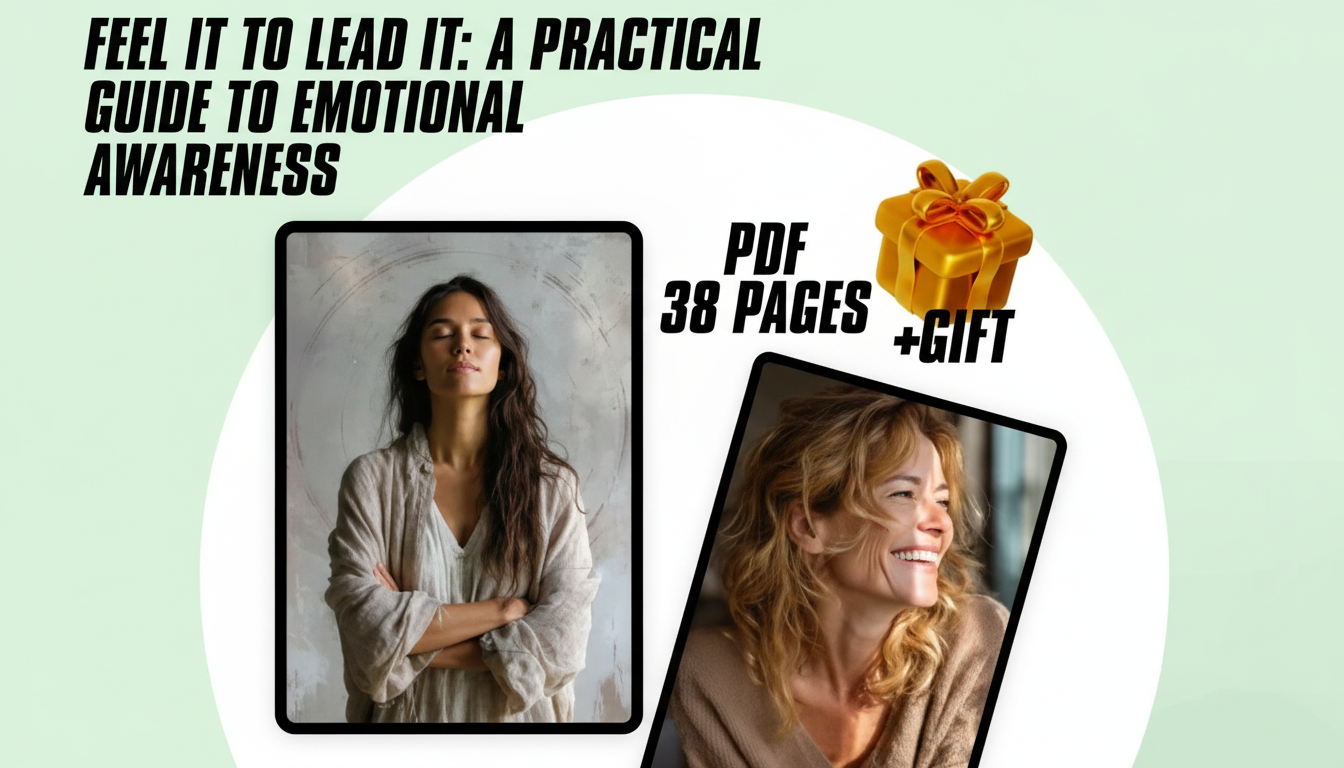
Feel It to Lead It: A Practical Guide to Emotional Awareness (eBook PDF Download)
Emotional awareness is the skill of noticing what’s happening inside—feelings, body cues, and thought patterns—before those signals drive decisions and relationships on autopilot. Feel It to Lead It: A Practical Guide to Emotional Awareness (PDF download) is a practical, training-style eBook designed to help build that skill with simple frameworks and repeatable exercises that fit into daily life and work.
When emotional awareness increases, communication tends to get clearer, conflict becomes easier to navigate, and stress reactions feel less “mysterious.” For a deeper look at why regulation skills matter, the American Psychological Association’s overview of emotional regulation offers a useful foundation.
What emotional awareness looks like in daily life
Emotional awareness isn’t about staying positive or never getting triggered. It’s about catching the early signals so you can respond on purpose.
- Recognizing early signals (tight chest, racing thoughts, irritability) before emotions peak and take over.
- Naming emotions with more precision than “fine,” “stressed,” or “mad,” which reduces confusion and knee-jerk reactions.
- Separating the emotion (signal) from the action (choice) so you can feel something strongly without acting impulsively.
- Noticing patterns: specific triggers, recurring situations, and protective habits like avoidance, overexplaining, or shutting down.
Inside the training approach: skills the guide helps practice
The eBook is structured like skill practice, not theory-heavy reading. The focus is small reps that become reliable under pressure—especially in conversations where it’s easy to get reactive.
- Body-based check-ins to identify intensity and location (where emotion shows up physically).
- Labeling and meaning-making: moving from “I’m overwhelmed” to “I’m anxious about uncertainty,” which immediately creates options.
- Trigger mapping: identifying the situation, interpretation, and the emotion loop that follows.
- Boundary and communication basics: stating needs without blame, lecturing, or shutdown.
- Reflection prompts that convert emotional moments into learning rather than regret.
Core skill areas and what to practice
| Skill area |
What it builds |
Simple practice |
| Noticing |
Awareness before escalation |
60-second body scan during transitions |
| Naming |
Clarity and emotional regulation |
Use an emotion word list; choose 2–3 precise labels |
| Understanding |
Insight into triggers and needs |
Write: event → story → feeling → need |
| Choosing |
Intentional responses under stress |
Pause, breathe, pick a next action aligned with values |
| Communicating |
Healthier relationships and teamwork |
Use: “When X happens, I feel Y, I need Z” |
Who this eBook tends to help most
Emotional awareness is broadly useful, but the biggest wins often show up for people who carry a lot of responsibility—or who learned to cope by pushing feelings aside until they spill out.
- Leaders and managers who want calmer, clearer communication during conflict or pressure.
- Professionals prone to overthinking, people-pleasing, or emotional shutdown—especially when stakes feel high.
- Coaches, educators, and caregivers who support others and need stronger self-awareness to avoid burnout.
- Anyone building emotional literacy for relationships, teamwork, and personal resilience.
For additional leadership context, the Center for Creative Leadership highlights how emotional intelligence supports effective leadership behaviors.
A practical routine: use the guide in 10 minutes a day
Consistency matters more than intensity. A short routine makes it easier to practice on normal days, so the skills are available on hard days.
- Morning (2 minutes): identify baseline mood, energy level, and top concern.
- Midday (3 minutes): check the body for tension; name the strongest emotion; rate intensity 1–10.
- After a difficult moment (3 minutes): write the trigger and the story the mind told; identify the underlying need.
- Evening (2 minutes): choose one lesson learned and one small adjustment for tomorrow.
What to expect from a PDF eBook download
- Instant access after purchase with a digital PDF format suited to desktop, tablet, and most mobile reading apps.
- Print-friendly prompts if you prefer handwriting reflections or keeping key pages visible during the week.
- Better results through repetition: the exercises work best when used in real situations rather than read once end-to-end.
- Simple tracking: save reflections in a dedicated folder or notes system to spot patterns over time.
If stress has been running high, pairing emotional awareness with basic coping tools can help reduce the “background noise.” The National Institute of Mental Health’s stress coping guide is a practical reference point.
Emotional awareness at work: fast tools for meetings and messages
Work is where emotional habits show up quickly—especially in email threads, feedback conversations, and fast-paced meetings. These quick tools help create a pause between feeling and reacting.
Product details and purchase option
Quick product snapshot
Helpful add-ons for building a steady practice
- Reduce baseline stress for better follow-through: Pair emotional awareness training with The Relaxation Hypnosis Checklist for Clarity (PDF) to support calmer daily check-ins.
- Keep it lightweight on busy days: A checklist approach can make routines easier to complete even when time is tight.
- For creators and small businesses: structured planning tools can reduce overwhelm and prevent emotional spillover into work—try The Ultimate Pinterest Power-Up Checklist if marketing tasks tend to trigger procrastination or pressure.
FAQ
Is this eBook suitable for beginners who struggle to name emotions?
Yes. It’s designed to be beginner-friendly with step-by-step exercises, support for emotion labeling, and short daily practices that build confidence without requiring prior experience.
How do I use the PDF without feeling overwhelmed?
Stick to a simple 10-minute routine and focus on one exercise at a time. Repeating the same prompt in real situations is more effective than trying to complete every page quickly.
Can emotional awareness training help with communication at work?
It often does because noticing triggers and naming emotions improves clarity and reduces reactivity. That makes it easier to have conflict conversations, ask for what you need, and respond to feedback without spiraling.
Recommended for you












Leave a comment